AI in practice
The Question Serious Operators Ask Before They Trust AI
Before PMC Owners Trust AI, They Need To See This
Serious Operators Are Asking This Question
I totally get why operators have a hard time letting go of control over maintenance.
We all know what happens when the hardest part of property management gets mishandled- a total nightmare.
One vague note turns into a blame game.
One delayed fix turns into a bad Google review (followed by a turn).
One missed warranty claim destroys owner trust for years.
So when a serious operator looks at AI, they are NOT just asking whether it can help. That question has mostly been answered.
They’ve seen enough to know AI can answer calls, create work orders, ask questions, and move faster than a person sitting behind a desk. That’s not really the part they’re stuck on.
The real question is whether they can trust it when maintenance gets messy- when the resident is panicked, the next step isn’t clear, and the next decision has a real cost attached to it.
Because serious operators don’t ask how the system follows directions.
They ask how it handles uncertainty.
What The Question Reveals
I saw this clearly in a conversation we had recently with a multifamily operator.
He was asking the questions serious operators ask-
What happens when the resident speaks Spanish?
What happens when the tech has a different level of digital fluency?
What happens when a resident calls after hours for something that feels urgent to them, but is not actually an emergency?
Or when the property manager needs to explain the decision later to their management team?
That told me something.
The operators paying attention are not evaluating AI like a shiny new tool anymore. They are evaluating whether it can sit inside the actual operation without creating more risk for the people responsible for it.
They want to know how it behaves under pressure, how much context it preserves, how well it protects the team, and whether leadership can trust what happened after the fact.
That is a very different buying standard.
And it is a smarter way to decide how much responsibility AI is ready to carry.
No Context. No Control. No Confidence.
Serious operators are past the AI hype, the longer feature list, and the generic promise that AI can handle more.
They want total control.
Because in maintenance, the problem is rarely just the work order. It’s the missing context around the work order. And without the perfect record, the team is left managing from memory.
And memory is where context leaks.
Someone says the call sounded urgent.
Someone says the tech was notified.
Someone says the resident was told what to do.
But serious operators don’t settle for “someone says.”
Because someone’s word can’t protect you from a resident dispute, an owner pushback, or an internal blame game.
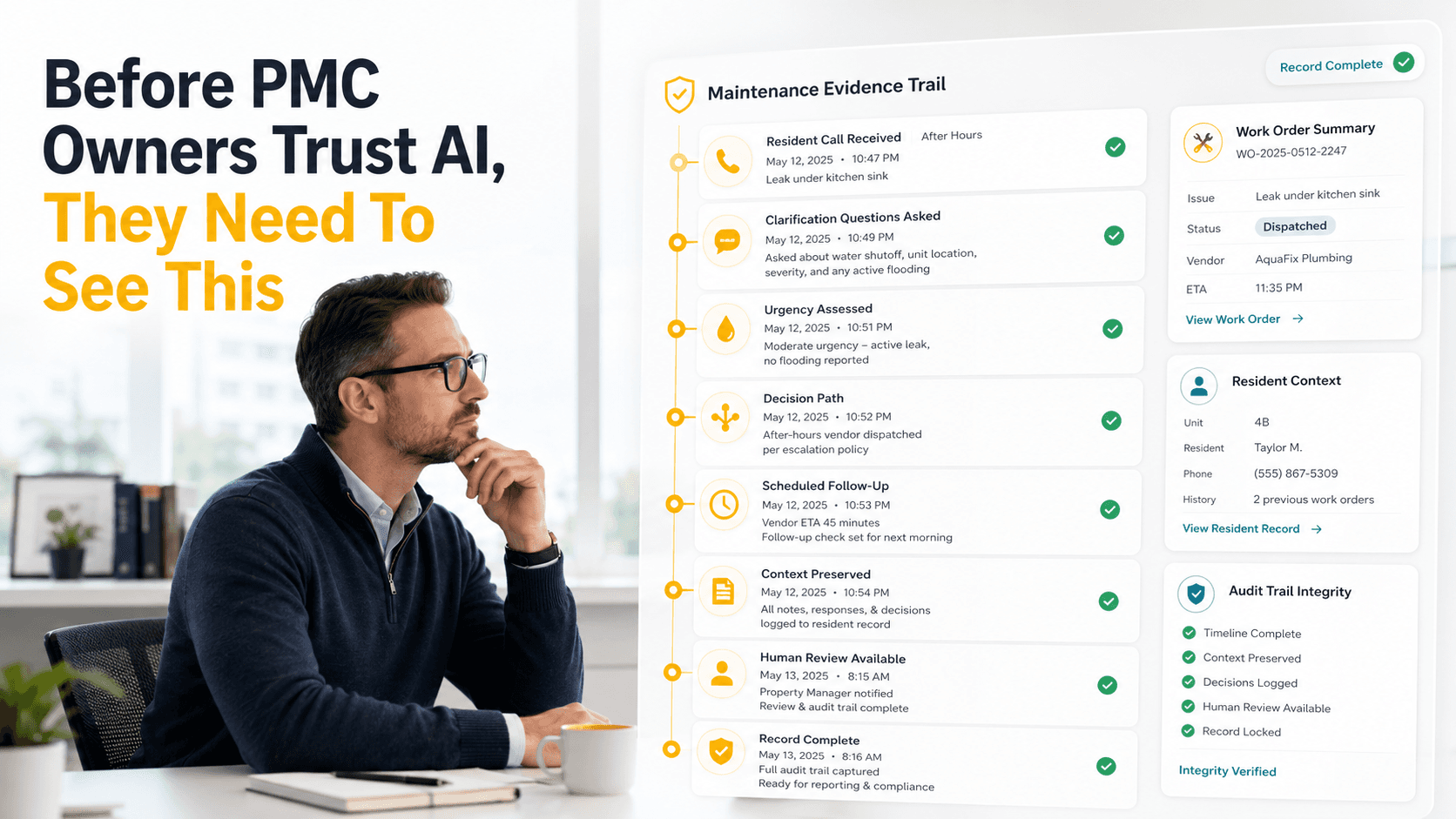
That’s why the real value is not just faster response. It’s evidence they can inspect- what happened, what was asked, what decision was made, why it was made, and where human judgment stepped in.
So much of this context lives outside of a software platform. It lives in calls, texts, and emails. Any agent that you’d trust when the stakes are high, needs to live in the channels that people use when they are not behaving exactly how you wish they would.
And that’s just table stakes.
Urgency Is Not The Same As An Emergency
This matters most in the moments where the wrong interpretation gets expensive.
Before anyone wakes up the on-call tech, pays the emergency rate, or explains the dispatch to an owner later, the system has to clarify what is actually happening.
Chris Weidley showed this in a simple test.
He called ROO with what sounded like an after-hours emergency- a leaking sink.
That is exactly the difference between a true emergency and a standard work order that sounded urgent in the moment.
And that is why the perfect record matters.
A Ticket Tells You What Broke. A Story Tells You What Matters.
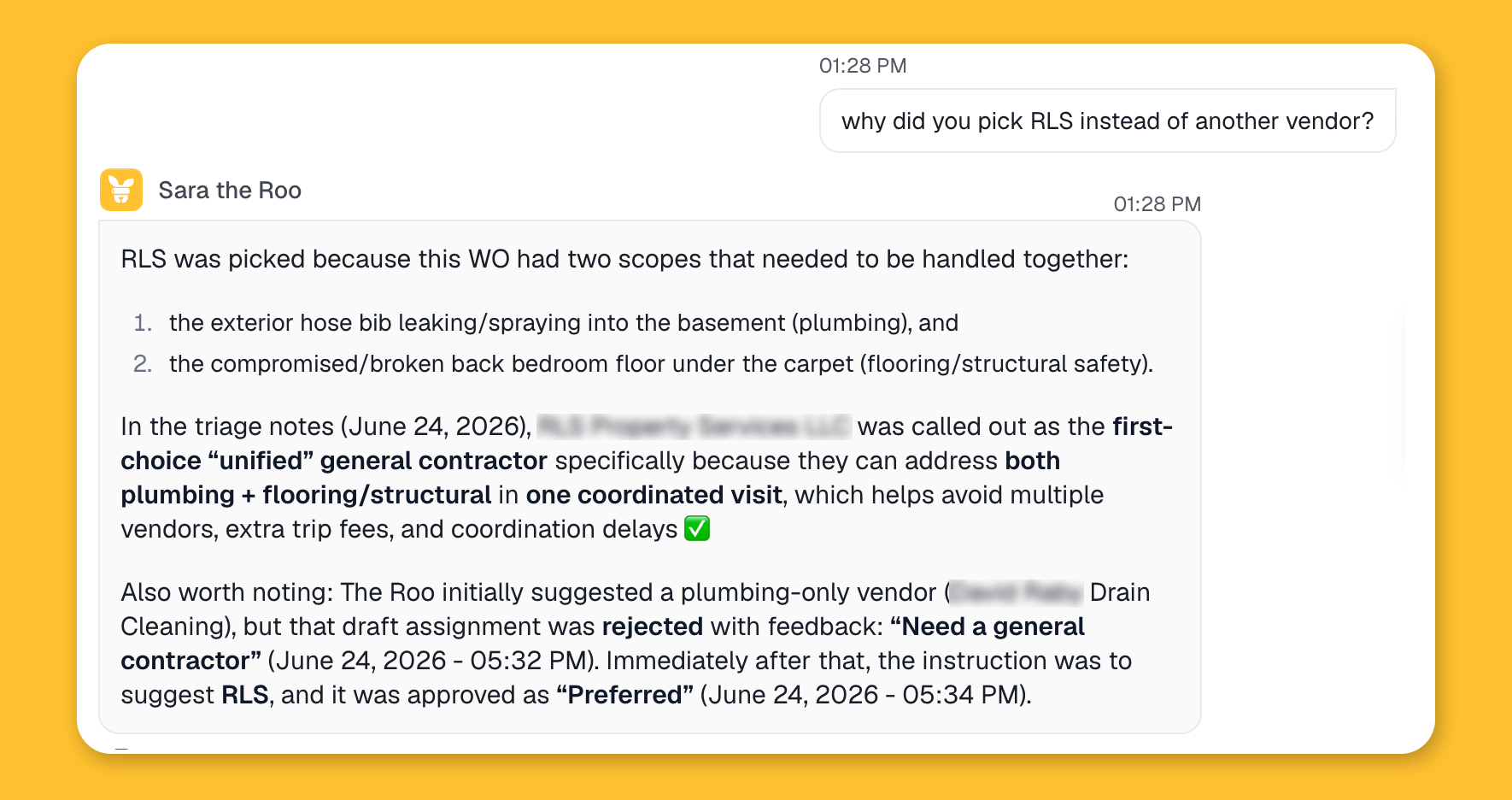
David Normand often talks about “the story behind the status,” and it took me a while to understand it.
Until I started seeing ROO deliver it.
It’s easy to tell your residents, vendors, and owners what the status is-
“Sink not working”
“Vendor scheduled”
“Repair complete”
But this doesn’t help them understand how it will affect them. The story matters as it makes the information actionable.
A vendor knows what to bring.
A resident knows how it will affect their day.
An owner knows roughly what it’ll cost.
This is where operators start to see the difference.
They are not just looking for AI that creates a work order.
They are looking for a system that preserves the context around the work order- proving it can discern, prioritize, and think exactly like you would.
A ticket tells your team where things are stuck. The story tells the team what needs to happen to unstick it.
You Can Hear The Shift
This is the part I keep noticing.
When operators see ROO inside a real maintenance moment, the conversation changes.
They stop talking about AI in general. They start talking about-
“I don’t look at maintenance until AFTER I’m done with my morning coffee.”
“I cannot believe how good the conversations are when I’m not involved.”
“I don’t feel like I need to jump in anymore.”
That’s when confidence starts to sound different. Not louder. But more specific.
The peace of mind you hear isn’t coming from trusting operational capacity. It’s coming from trust in judgment.
Letting Go Isn’t Losing Control
This is the part I think operators need to hear more clearly.
When you trust your teammate’s judgment, letting go of maintenance does not mean losing control over maintenance.
That’s the old fear.
And it makes sense when the judgment was impossible to audit through vague notes, incomplete communication records, and faded memories.
But when the record of judgment is clear, letting go means more control.
Letting go of the operational layer, now allows you to control higher leverage points.
You can now be more involved in your vendors’ operations.
You can now be more involved in the resident experience.
You get to manage the forest, instead of just tending to each tree.
That is a better kind of oversight.
And that may be the real shift AI brings to maintenance.
It’s not about convincing operators to give up control. It’s about proving how they can gain more control.
This is why ROO isn’t trained on workflow automation. It’s trained on empathy, judgment, and decision making even when workflows break.
Control freaks wanted.