AI in practice
The 3 AI Implementation Mistake That Creates More Work
3 Mistakes To Avoid With Agentic AI
A resident put in a maintenance request at 7:00 PM on the Fourth of July because her washing machine wasn’t working.
She wasn’t expecting anyone to answer. She just wanted it in the system so somebody could deal with it after the holiday.
Except an AI teammate responded.
By 10:00 PM, it had walked her through the issue, found the gunk causing the problem, and helped her get the machine working that night.
That’s the AI story everybody wants.
Instant response.
Happy resident.
No vendor dispatch.
No maintenance coordinator pulled into a holiday emergency.
Easy win for AI. But if you’re like most people, deciding to move forward with AI isn’t about the wins it can deliver. It’s about avoiding failures.
So we need to talk about when AI fails- when the workflow hits a dead end.
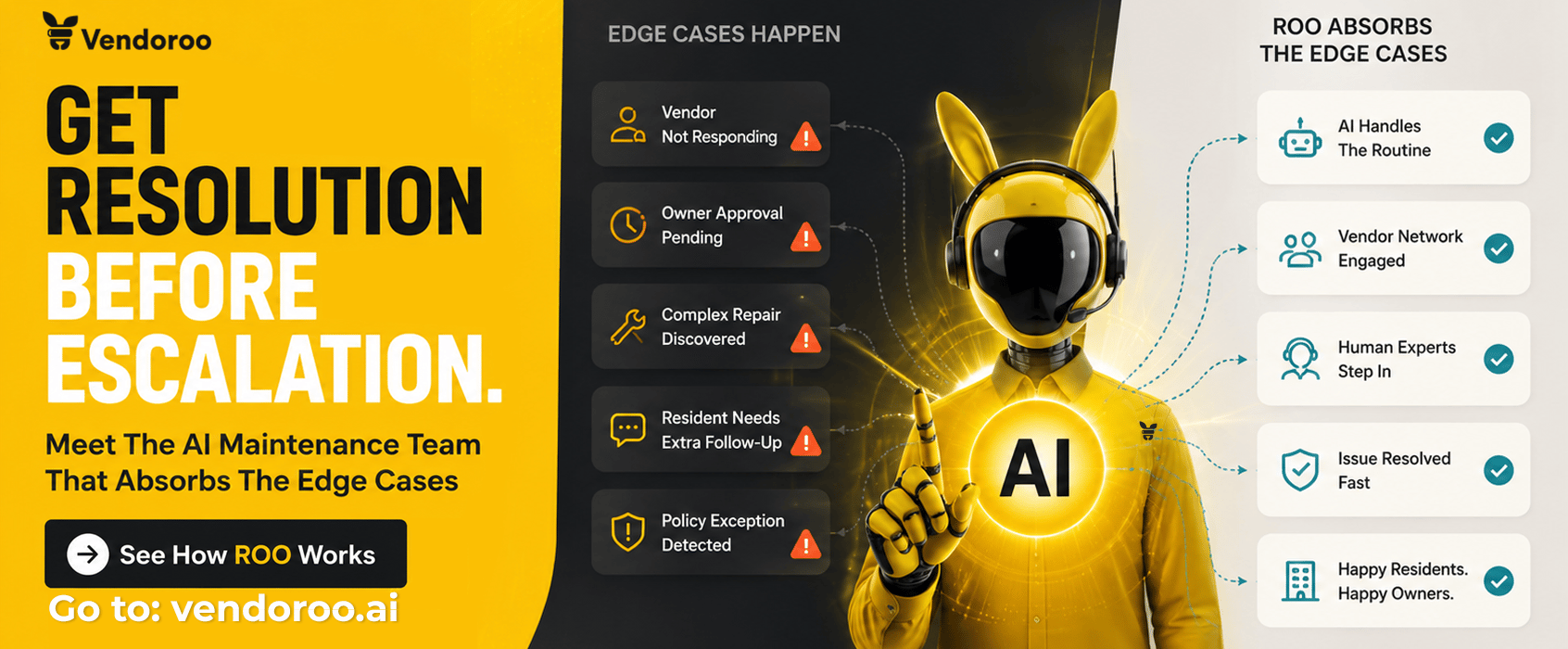
The vendor stops responding. The owner sits on an estimate. The resident needs a third follow-up. The AI runs into a policy that lives in someone’s head but was never written down.
And when those edge cases start falling back into your team’s lap, your team loses trust fast.
Because your people may not be thinking of this as “AI progress.” They’re likely thinking they just got a new special request to babysit. And on top of that, this special request could take their job.
After 500+ agentic AI deployments, we’ve seen 3 mistakes that decide whether your AI program becomes a trusted teammate- or another failed rollout your team learns to work around until you cancel it.
This is why Vendoroo isn’t just built to automate maintenance tasks.
It’s built to keep the work moving when the workflow breaks- with AI handling the routine decisions and trained human experts absorbing the edge cases before they fall back on your team.
Mistake #1: You Installed It Instead Of Onboarding It
Most operators still think about AI like software.
You buy it. You plug it in. And you expect it to work. And with most software, that makes sense.
But a plug-and-play product is usually about as good as it’s going to be on day one. Maybe you submit a ticket. Maybe a feature request gets added six months later. Maybe it doesn’t.
So you learn how to use the tool as-is.
But an AI agent is different.
It’s more like a new employee. And even if that employee has 15 years of property management experience, day one should still be their least useful day inside your company.
Think of it as hiring a great coordinator who just moved to Florida from another state. They may know maintenance cold. But the first time a resident has a water heater issue, they might ask them to check the basement.
And as their boss, you say: “Hey, we don’t really have basements here. Ask them to check the garage or utility closet instead.”
That doesn’t mean you made a bad hire. It means your new teammate just learned something about their new environment.
Onboarding an agent works the same way.
It should know the workflows, but during onboarding, it has to learn your owners, vendors, properties, approval rules, and local quirks.
That’s why the first phase should feel a little like being an overprotective parent.
You watch.
You learn about what it can do well, and not so well.
You give it feedback and it learns from you.
And once the agent learns one of those nuances, it remembers it permanently. Which means you are not teaching the same thing over and over. So you trust it enough to start delegating work.
Just like an employee.
500 deployments in, the winning pattern has emerged: Learn. Delegate. Optimize.
Our most successful clients spend the first 30 days, learning from their ROO, and giving it feedback so ROO learns from them.
Over the next 30 days, they go from overseeing everything to delegating duties, answering escalations, and spot checking work. The way you’d hope to treat a new, promising employee.
Once the AI is handling the work consistently, they feel confident enough to start working on the things they always wanted to get to, but kept getting bogged down by maintenance.
This is exactly what making and onboarding a great hire should feel like, and it’s the exact way you should approach onboarding an agent to maximize the chance you succeed together.
Mistake #2: You Bought Your Team An Interruption Machine
The point of onboarding a new teammate is to eventually delegate. But people are quick to quit on delegation when they feel like they’re doing too much babysitting. So they decides to just do it themselves instead, and tell you the new kid “doesn’t have it.”
So here’s the question I would ask every AI provider before trusting their agent with maintenance:
When the workflow breaks, whose workday gets interrupted?
Because it will break.
A vendor uncovers something…
A resident needs you to deal with their roommate…
An owner disappears when you need approval…
A completed repair turns out was incomplete…
Those aren’t rare situations in property management. That’s Tuesday. So it’s natural for your existing team to get frustrated if the new teammate can’t think through it.
So when the new AI gets to end points that aren’t clearly defined, but obvious to someone who used to have that role, it’s easy for it to feel like “another thing to babysit.” Especially if they haven’t fully bought into the teammate mentality yet.
That is often the final blow to any hope of getting your team to buy in.
At Vendoroo, we’ve quantified the sheer volume of these scenarios firsthand. We’re now handling roughly 14,000 edge cases every month- the moments where a workflow needs judgment, correction, or a human safety layer to keep moving.
This is why we don’t believe an AI agent alone is enough to help most teams succeed. They need a smart escalation strategy that starts with someone on the AI provider’s team handling the escalations they’ve seen elsewhere and someone on the PM’s team to handle the truly unique situations.
That way your team isn’t bearing the brunt of the initial learning curve as they learn, themselves.
Whether you’re building or buying agents-
If you don’t have a smart escalation strategy to absorb those interruptions, the person you’re asking to delegate their work to your AI may never have the bandwidth to do so.
We got tired of seeing it happen.
Mistake #3: Letting Your Team Think AI Is Their Competition
This one is uncomfortable. But pretending it isn’t a threat makes it worse. Think about it-
Your team is hearing AI is coming for their jobs everywhere on social media.
Then leadership walks in and says, “We’re bringing in AI to automate your work.”
What do you think happens?
Resistance isn’t irrational. It’s predictable.
We may think we’re showing them a better way to run a business, but it often comes across as “look how replaceable you are.” What we have seen work really well is when leadership takes time to paint the picture of what is truly in it for them.
It’s as simple as saying: “This used to be your day…”
- Triage the request
- Assign the vendor
- Schedule the work
- Chase the update
- Confirm the repair happened
- Close out the work order
“Now ROO handles the routine coordination so you can focus on the work I’ve always hoped for you.”
That means having the time to really review true escalations. Spotting delays before they become owner complaints. Watching resident sentiment so your team can put out embers before anyone is too upset.
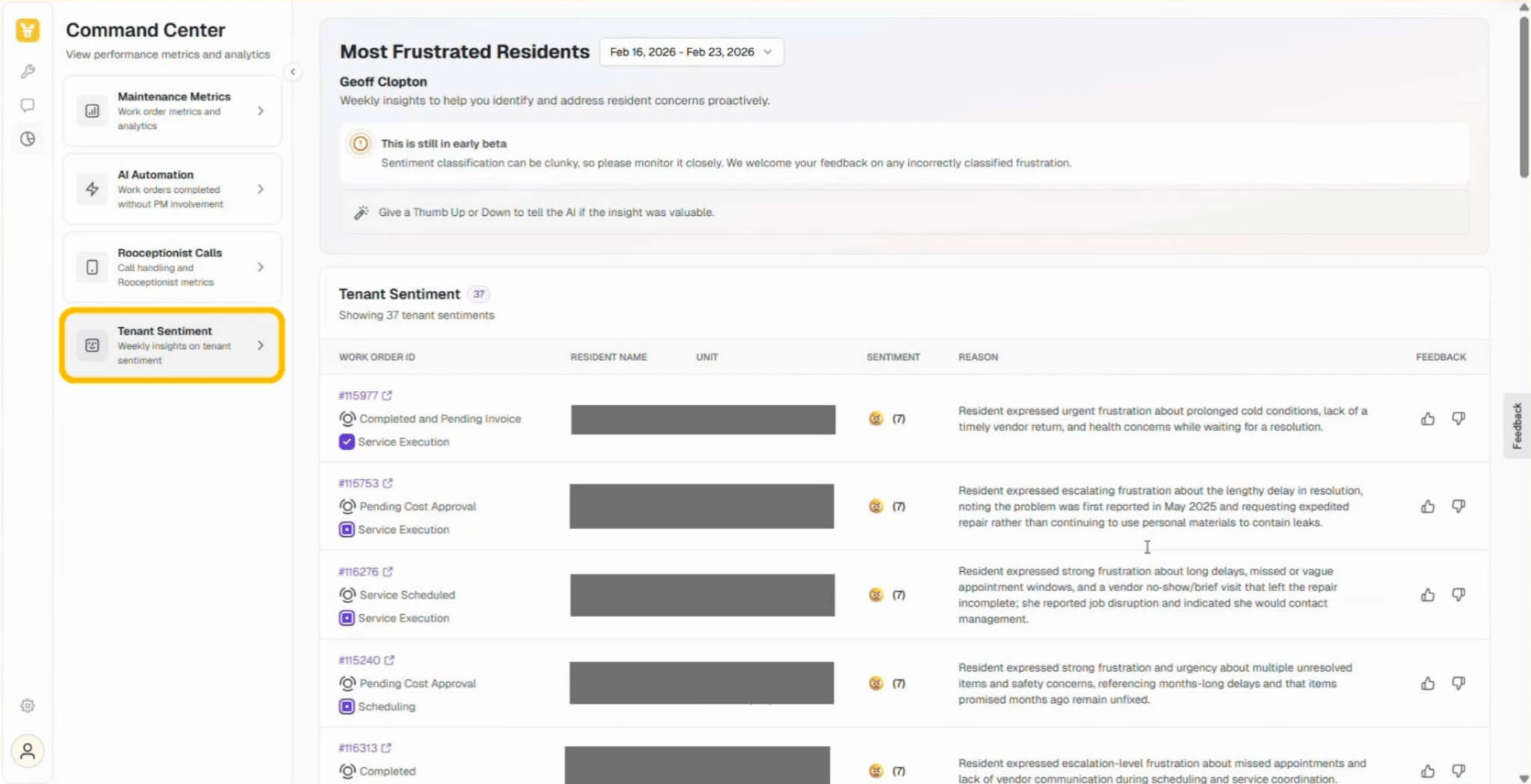
That is the job your team actually wants- staying ahead of the embers instead of being controlled by the fire.
So don’t frame it as: “The AI is taking work away from you.”
Frame it as: “The AI is taking work off your plate so you can do the work only you can do.”
When AI Can Do The Job, What Happens To Your Team?
When AI starts working, every operator will have the same choice.
Do you automate away from humans?
Or do you automate toward them?
We had this choice too. And here’s the story.
Before ROO became what it is today, Vendoroo started as a remote teammate maintenance operation. Our people were using AI to help them handle intakes, calls, decisions, vendor coordination, and all the mental weight that comes with maintenance.
Because we first had to own the maintenance outcome ourselves.
Then the AI got better. It started making decisions. It started taking action.
So we went from human-led, AI-assisted to AI-led, human-assisted.
That’s when we found ourselves at a leadership offsite in Sonoma asking the same question operators are asking right now:
“What do we do with this team now that the AI can do so much of their old job?”
For us, the answer was clear-
The most AI company should be the most human company.
So we chose to automate toward humans, not away from them.
That team of 50 maintenance experts became the human layer behind ROO- helping customers normalize operations, handling edge cases, and providing the safety layer when judgment is required.
Because when AI takes over the repeatable work, the real opportunity is not to make humans less important.
It’s to put them in roles where they create the most value.
This Is Not Really About The Technology Anymore
This conversation started as a technology conversation.
But it’s not about technology anymore.
That was what the early adopters cared about- who had the newest AI, who had the most automation, and who could get there first.
But if you're still evaluating how to transform your organization with AI, it's probably not because you doubt the technology.
It's because you understand that getting started the right way matters.
You understand that you can't keep asking your team to try new tools, watch them fail, and then expect them to trust the next one.
You understand this AI race is too important to lose your team's trust in it.
So the decision is no longer: "Should we use AI?"
The decision is: "How do we make sure this succeeds?"
Knowing these three mistakes will help you do that.
But working with a team that has already seen them, solved them, and helped hundreds of operators move past them will help you even more.
If you want the full story, including the implementation framework we've developed across 500+ agentic AI deployments, watch the full talk below.
Pablo Gonzalez
Chief Evangelist at Vendoroo