Software & industry
New PM.com Maintenance Rankings & A Big Shift Is Obvious
Maintenance Is Moving From Workflow Management To Experience Management
Maintenance Tech Is Splitting Into Two Architectures
The newest Maintenance Software Category Report is out.
And two things immediately stand out.
First- the top three platforms were separated by just 1.01 VPI points. The tightest race of any major software category measured so far.
Property Meld finished at 86.96.
Mason finished at 86.49.
Vendoroo finished at 85.95.
According to the report, it’s a statistical tie.

But the bigger signal in the report isn’t the leaderboard itself.
It’s that the maintenance category is starting to split into two completely different architectures.
One model still depends on humans coordinating the entire maintenance workflow manually- assigning vendors, chasing updates, following up with residents, moving work orders bucket by bucket.
The other uses AI to absorb the coordination layer itself- leaving humans focused on escalation, judgment, relationships, and experience.
That shift is all over this report.

And the metrics inside it make the direction even clearer.
The Metrics Quietly Revealing The Shift
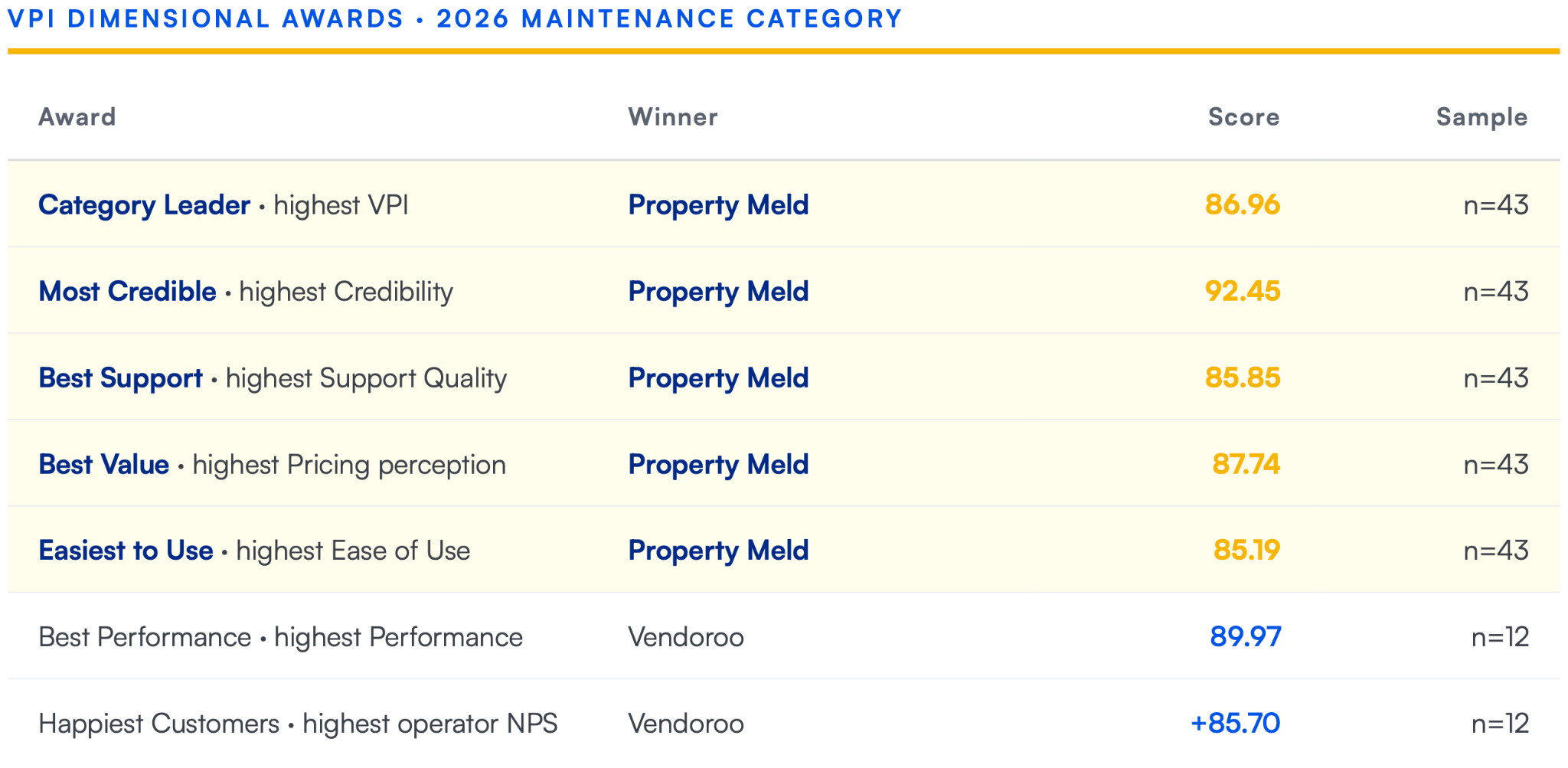
The report ranks 6 subcategories, that add up to an overall category winner.
But not all subcategories measure the same thing.
Some measure market trust and platform maturity:
- credibility
- support quality
- pricing perception
- ease of use
Those metrics tend to favor established platforms with longer track records and broader market familiarity.
The others measure operational outcomes:
- performance
- operator satisfaction
And those outcomes have always been the thing that mattered most to property managers.
Because maintenance has never really been about moving work orders. It’s about protecting the resident experience while the work is happening.
Protecting owner confidence.
Reducing operational chaos.
Creating calm instead of friction.
The difference now is that AI-native maintenance platforms can finally influence those outcomes directly. That’s the architectural shift happening underneath this report.
You no longer need to do maintenance the old way. Let Vendoroo handle coordination so your team can focus on what matters most- making investors and renters happy. Schedule a demo.
Not A Software Shift. An Outcome Shift.
The report starts making more sense once you realize these platforms are solving two very different problems.
Traditional maintenance software was built to help humans manage workflows more efficiently.
Figure out what’s wrong → Create a work order → Assign the vendor → Track the status → Coordinate the process → Follow up & verify everything.
Because the human coordinator still sits at the center of the system.
AI-native maintenance platforms are built differently. Instead of helping humans coordinate maintenance faster, they’re starting to absorb the coordination layer itself.
Intake → Decision → Vendor selection → Coordination → Close out… all done for you.
This is the repetitive operational motion maintenance teams have historically spent most of their day managing.
And once that coordination burden starts disappearing, the value of the human role shifts too.
Less time pushing work orders forward. More time protecting the actual experience surrounding the work.
That’s why the outcome metrics in the report start moving differently than the trust and maturity metrics.
The architecture underneath the operation changed. This naturally changes the outcome too.
What The New Architecture Actually Creates
Once the coordination layer starts disappearing, the maintenance coordinator’s role changes completely.
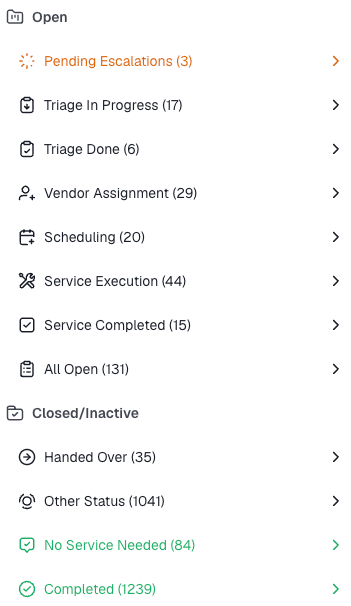
The old model required humans to sit inside the workflow all day:
- triage
- vendor assignment
- scheduling
- follow-ups
- status checks
- service execution
- closeout verification
That operational load is exactly what created the constant feeling of being behind.
And most of it had very little to do with improving the resident experience itself.
Now the AI handles the repetitive coordination motion automatically.
Which means the human no longer spends their day managing every work order.
They only need to click into escalations, answer the question the agent is getting stuck on, and then move onto more meaningful work.
That’s the first order benefit-
Space.
The true outcome shift happens at the intersection of what AI can do for you… and what it enables you to see.
For the first time, the system has visibility into the operational health of the maintenance experience itself.
That creates an entirely new layer of intelligence.
For example, ROO’s Command Center surfaces real-time resident sentiment.
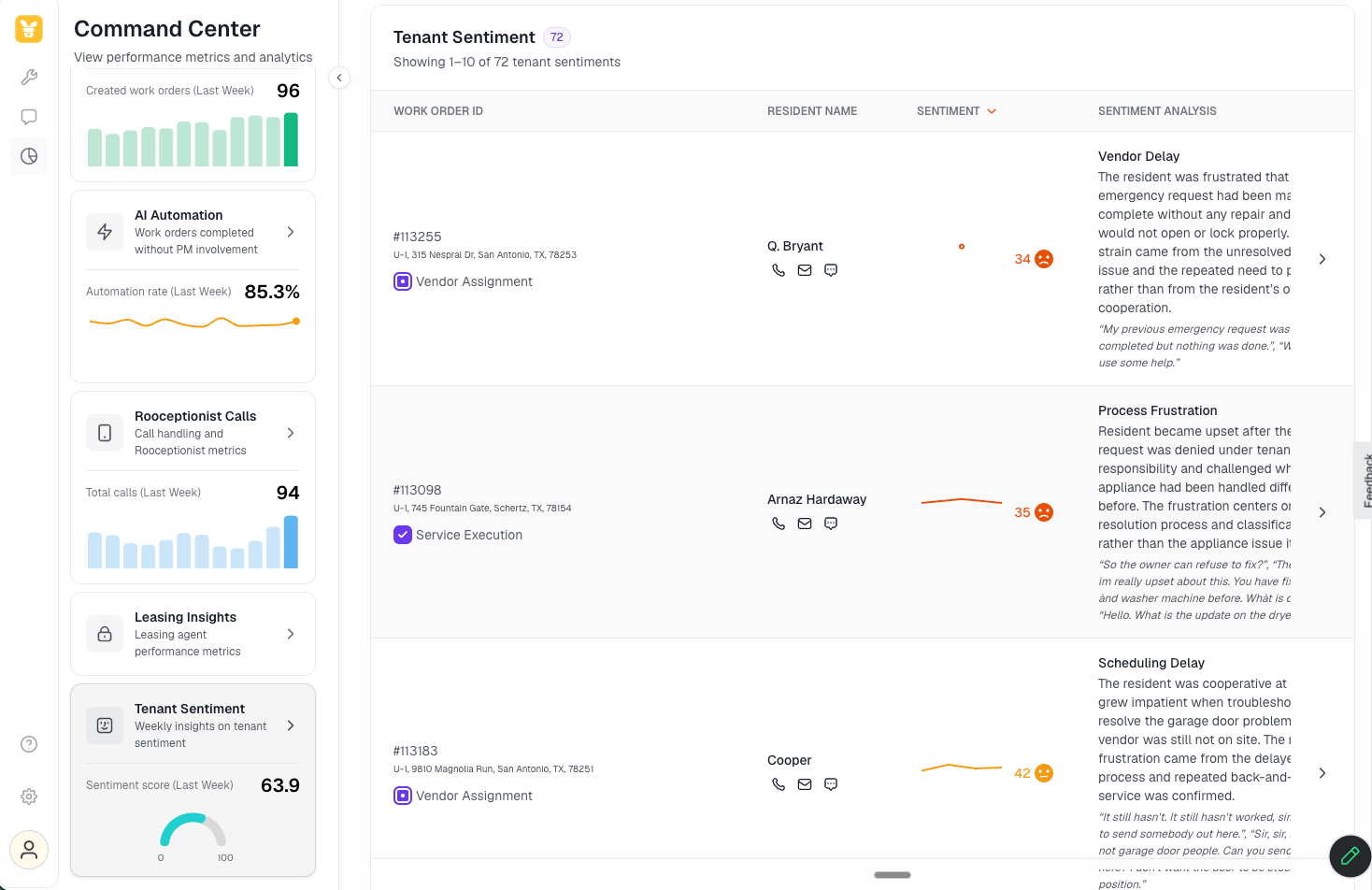
It can detect when:
A resident’s tone shifts negative.
A vendor delay compounds frustration.
A repair starts drifting toward an owner decision.
ROO flags the issue while the work order is still unfolding- giving the property manager the ability to step in early and protect the relationship before the experience breaks down.
That’s the difference between tracking workflows and understanding operational health.
Old systems could tell you where the work order was.
This tells you where the experience is heading.
Put Out Embers Before They Become Fires
This is why Vendoroo scored so highly on outcome-based metrics.
Because reaching out to a resident before they think you don’t care is what stops bad Google Reviews from happening.
And stopping bad reviews before they happen is what keeps investors as clients.
Putting out embers before they become fires is what drives stronger operational performance and higher customer satisfaction.
That’s the new promise of AI-native maintenance, and what ROO was designed to do.
Handle the repetitive coordination work automatically, give property managers visibility into the health of the experience while it’s still recoverable, and create the capacity to improve it.
Because the real goal was never better workflow management.
It was always better experiences for:
- residents
- owners
- vendors
- and the teams running the operation itself
That’s how better maintenance operations create better property management businesses.
The old maintenance model helped teams survive chaos.
The new one helps teams prevent it.
Because resident experience is rarely lost during the fire itself.
It’s lost in the embers before it.
Don’t wait for the fire to tell you something was already burning.
Pablo Gonzalez
Chief Evangelist at Vendoroo
Put out embers before they become fires with Vendoroo. See how it works HERE.