Growth & owners
20,000 Doors Later... Was All That Necessary?
How Would You Build Evernest Today? Scaling to 20k Doors in the AI Age
🎧 Listen to the Audio Version
I was halfway through Matthew Whitaker’s conversation on Peter Lohmann's podcast when he casually said they’re at almost 20,000 doors across 19 states- after buying 17 companies- and I had to pause it. I just sat there for a second thinking about the weight of that machine. 500+ employees. Layers of departments. Years of handoffs.
My first thought- “DAMN THAT’S IMPRESSIVE!” It breaks my entrepreneur mind to think of the skill set and grit needed to build something like that. Then the next thought hit me-
What if he had to build it today?
Because when you really listen to what it took to scale Evernest, you start to see the scaffolding behind the growth. The org chart. The inflection points. The limits.
How much of that architecture would be necessary today… and how much of it was compensation for the tools they had at the time?
Last week, in Language Creates Thinking, we named three shifts that separate legacy PM from AI-native PM. Listening to Matthew describe the climb to 20,000 doors, I realized we’re about to test that language against one of the biggest scaling stories this industry has ever seen.
PROPERTY MANAGEMENT IS TWO BUSINESSES
"I think there’s two big pieces to property management. The first thing is just execution, like a high level of execution. What we have found is there’s very little communication when there’s a high level of execution going on."
— Matthew Whitaker, CEO of Evernest
Read that again.
That’s not just a clean soundbite. It’s a structural truth.
A few weeks ago, in the David Normand piece - 1 Maintenance Coordinator Can Handle 2k Doors - we broke down the FedEx Method. The conveyor belt. defined work versus undefined work. Logging, updates, follow-ups - same way every time. And then the moments that live in context - the judgment calls, the “this feels off” decisions, the relationship moves that never make it into the SOP.
Whitaker just described the same split from the other side of the mountain - at 20,000 doors.
Execution is the defined work. Communication is the undefined work. And when execution is running clean, communication drops precipitously in quantity… and goes up in quality.
That’s what happens when you deploy agentic AI as a teammate correctly.
Watch Matthew Whitaker describe execution vs. communication on Peter Lohmann's Podcast.
THE GENIUS WITH 1,000 HELPERS
Before Evernest was departments and dashboards and regional leaders, Matthew had the context in his head. Owner nuances. Vendor preference. Property quirks. The “why” behind every decision.
To grow, he had to document and share as much as possible.
"I call it the genius with a thousand helpers. You have all the context in your head. But as you scale the organization, I just remember the first time that we managed a home that I’d never seen."
— Matthew Whitaker, CEO of Evernest
As the org chart grows, that context gets diluted across multiple people and layers. It relies on each person to document, share, and continually update. These are inflection points in capacity that often come with inflection points for the client experience.
Training an AI agent feels very similar to the early phase of contextual learning for a new team member. But it isn’t followed by the same inflection points in growth and quality.
The founder may still be the genius, but everyone on the team gets a thousand helpers now. Increasing capacity is no longer a quality risk. We actually see it become a strength.
I hosted a customer panel recently, and asked them what the biggest benefit was in their investment in Vendoroo. I was surprised when they all said a version of the same thing:
“AI helps us create a consistent experience for renters, vendors, and owners at the level used to only get from our best people.”
SOFTWARE AMNESIA
Matthew tells a story that illustrates the biggest “AHA” moment the industry needs (in my humble opinion)-
He got billed for a yard cleanup at one of his own properties. Three months later, a different property manager reached out asking to approve another cleanup for the same issue.
"I’m getting to eat some of my own medicine... the system should have informed her that, hey, we already paid for this."
— Matthew Whitaker, CEO of Evernest
I’ve lived this exact moment as an investor. A roof repair that should’ve been covered by warranty that I was about to shell out $3k for until my wife figured out the PM missed it. Nothing erodes trust in a PM faster than that.
This is why if there is ONE WAY to stop owner churn, it isn’t measuring NOI for them, it’s preventing Kitchen Table Arguments (the moments investors experience that precede owner churn.) I wrote about that dynamic here: The NOI Mirage And The Metric That Really Matters Most To Property Managers.
A System of Record only knows what someone remembered to type into it. Under real workload, people skip notes, close tickets without logging outcomes, and move to the next fire. An AI-native System of Action doesn’t rely on memory discipline because the record updates as part of doing the work.
This is where the increased quality of experience comes from.
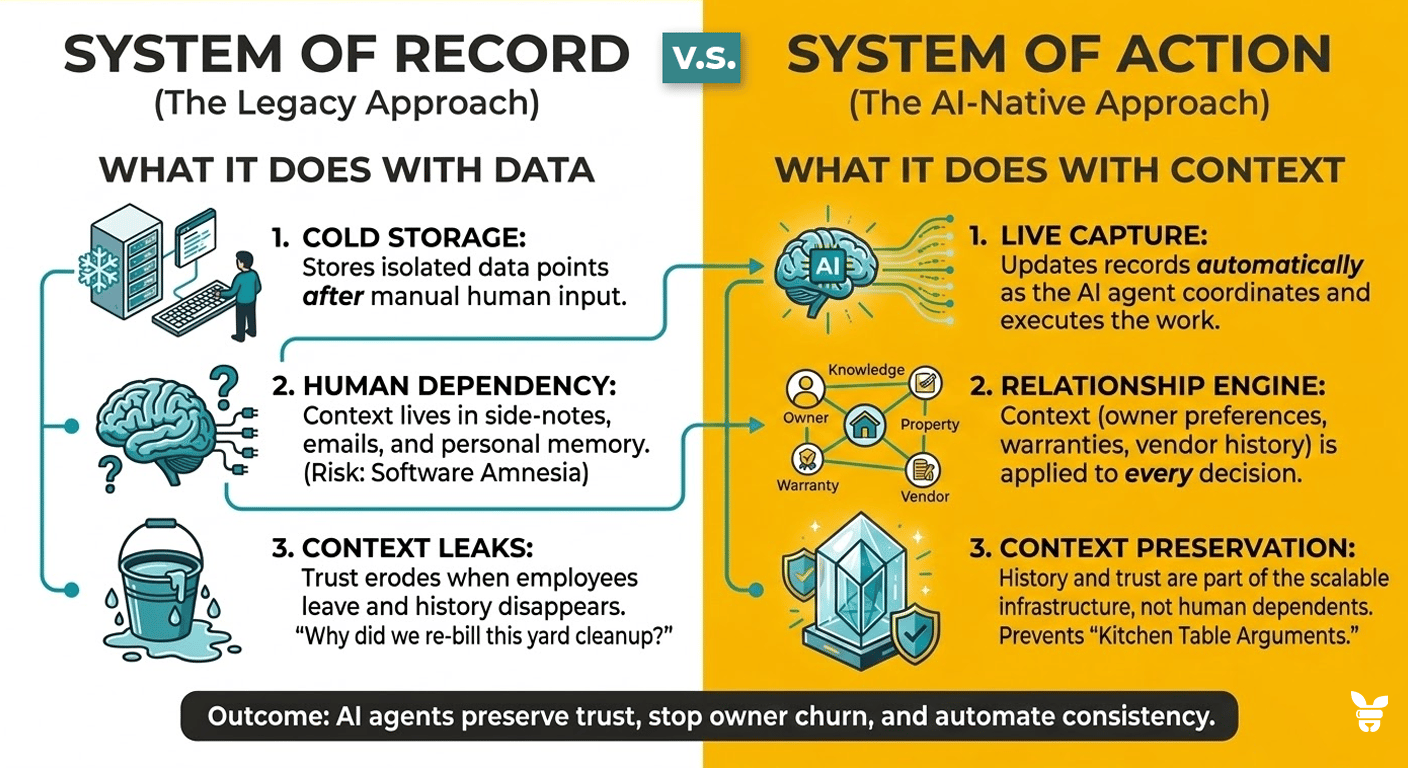
The shift from System of Record to System of Action isn't theoretical. It's running inside real maintenance queues right now- where context has to travel with the work or trust erodes fast.
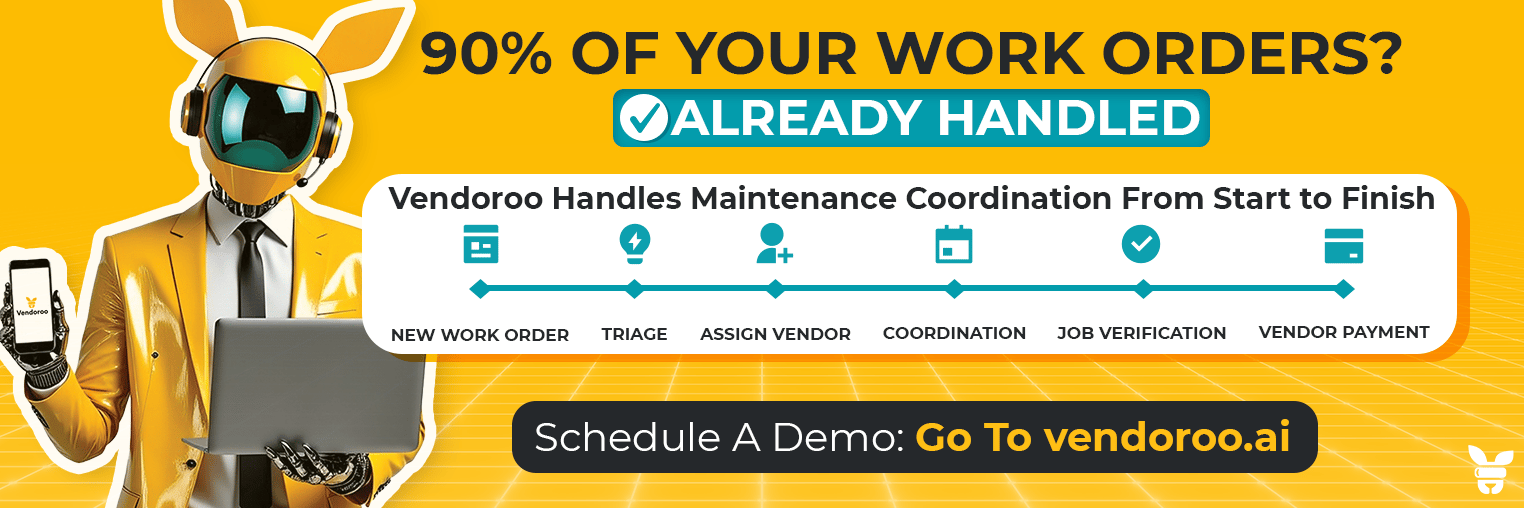
Curious how Vendoroo actually works? See what that looks like.
THE AIR TRAFFIC CONTROLLER
Departmentalization worked - at first.
Execution inside each lane improved. Leasing got sharper. Maintenance got tighter. Accounting had its own cadence.
But the moment you split the work, you create handoffs. And handoffs are where context leaks.
"The challenge with departmental is the handoff... that’s where the balls get dropped. We think of our PMs as almost like air traffic controllers... orchestrating all the departments."
— Matthew Whitaker, CEO of Evernest
But here’s the real consequence most operators miss.
The moment your PM becomes an air traffic controller, they also become the only person holding the full story of that property. Investors know this.
I recently hosted the Not Your Average Investor Summit, when I asked our investor community what scared them the most about holding onto their properties, and the answer was pretty clear-
It was losing their PM contact.
Investors have been trained to believe something the industry has just had to accept and try to build around: context lives in the relationship.
When that person leaves, the new PM can’t start from zero. The owner can’t need to repeat their story. The vendor relationship can’t feel like a reset. That’s what kills trust.
Yet, this happens often.
The real opportunity for AI isn’t replacing that role. It’s protecting it. That’s why the 2,000 doors per coordinator benchmark matters so much.
Not because we want fewer people.
Because the people who own the long-term relationships with owners and vendors will only stay on the team long-term if they are doing the work that fulfills them- not spend 60-80% of their day on mundane updates.
Watch Matthew Whitaker describe triangulating three systems on Peter Lohmann's Podcast.
Shifting the work we ask people to do is THE game. Everything else is just incremental software improvement.
THE CALORIE TAX
Here’s where it stops being operational and starts being personal.
"You go from managing properties which have clear answers to managing all the problems without clear answers... that is taxing... you burn a lot of calories."
— Matthew Whitaker, CEO of Evernest
That’s the part nobody puts on the growth slide.
When Evernest crossed 300+ employees, EOS cracked. They moved to Scaling Up. Pace Level 10 meetings. Layers of managers whose job was to make sure Department A knew what Department B was doing. Structure built to protect structure.
That’s the calorie tax that Tim Richards, from RPM Titan, quantified nicely-
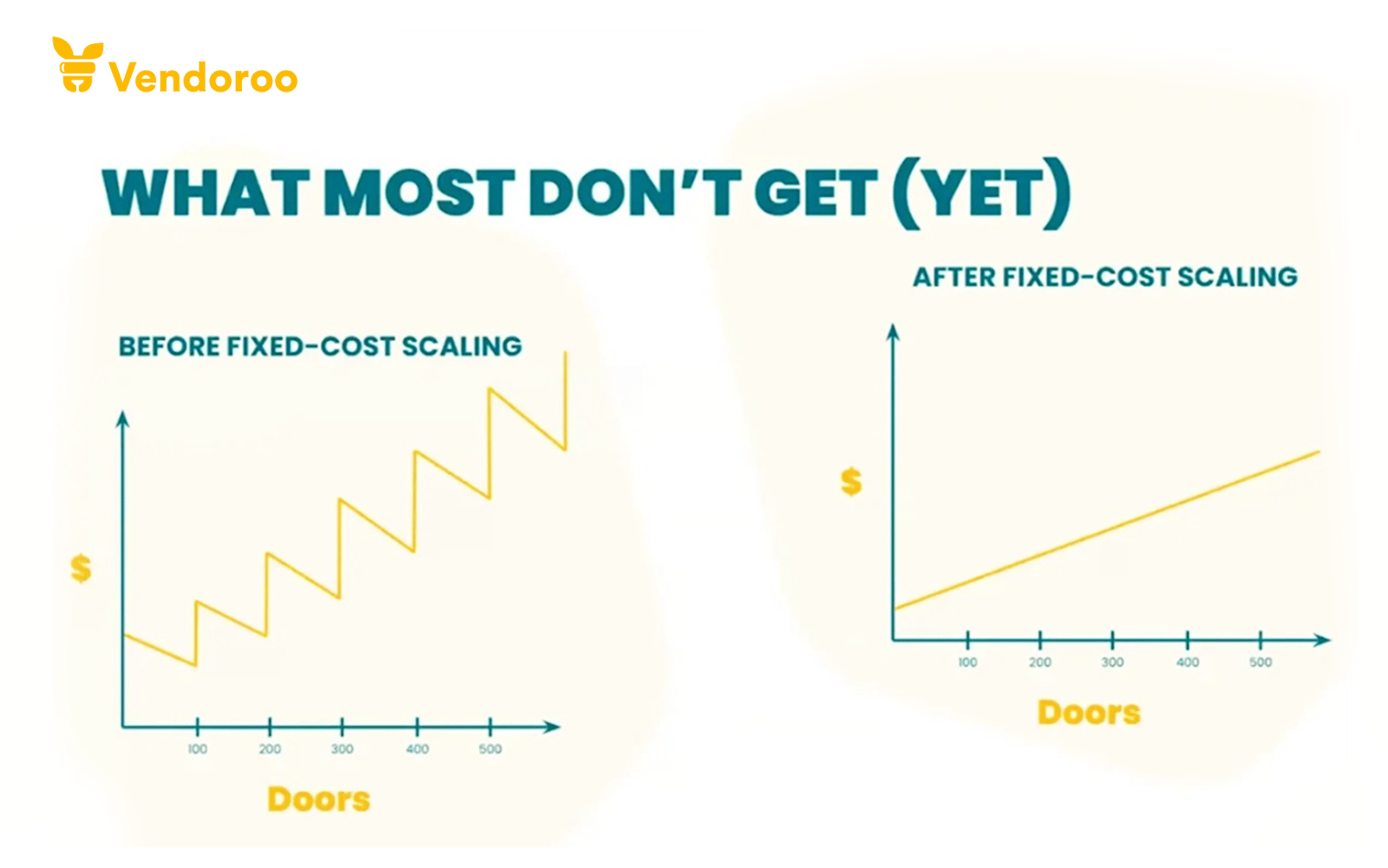
He wanted an experienced, in house, operator costs that would cost him at least $5,000 a month. At his average rents ($3K/mo), that means he would have to add 16.5 doors just to pay for the seat.
If that person decides six months in this isn’t for them? He would’ve basically just churned 16.5 doors.
This is why he decided to pursue a Fixed Cost Scaling with AI strategy. One where marginal cost per door stays flat because context is carried by scalable infrastructure, not by humans and their unpredictable returns.
That’s why he chose Vendoroo as a partner to grow his operation.
With fixed cost scaling, growth still has growing pains for the operator. But the effort feels much more like an investment than a gamble. More importantly, old clients no longer suffer from your need to keep new clients happy.
INDIGESTION CITY IN THE STATE OF ACQUISITIONS
Then came the acquisitions.
Seventeen companies in the back half of 2022. A sprint. A surge. A statement.
And then- indigestion city.
"Most companies don’t die from starvation, but from indigestion."
— Matthew Whitaker, CEO of Evernest
When a PM leaves, the relationship walks out the door.
- The owner history
- The "don't call after 6pm"
- The vendor who always bids high on this property
- The context that never made it into the notes field
"When a PM leaves, the relationship walks out the door... it's really hard to hand that off because the next person lacks context."
— Matthew Whitaker, CEO of Evernest
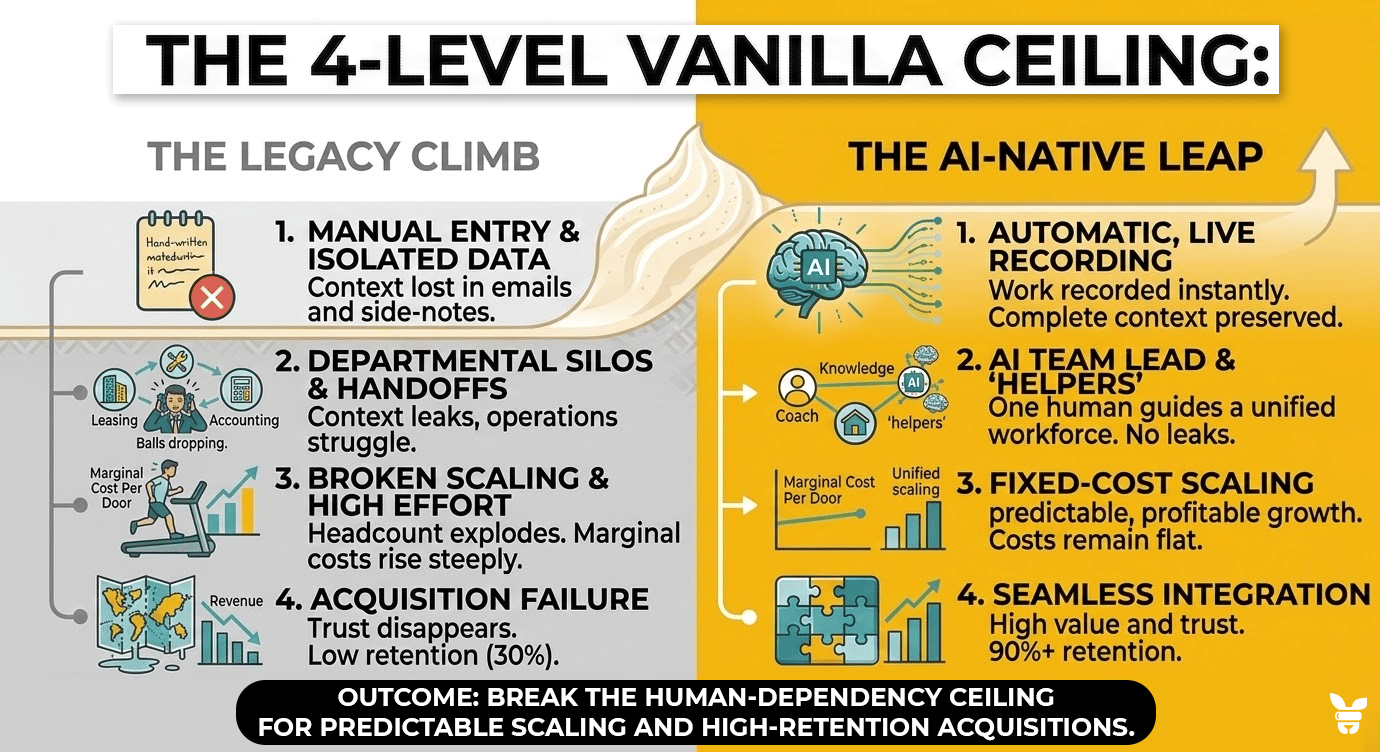
Evernest ran cohort analyses on their acquisitions. Some retained only 30% of acquired revenue three years later. The asset lost value after the deal closed - not because the doors disappeared, but because the context did.
When the humans turned over, the value leaked - because the technology stored transactions, not trust; the org chart stored roles, not relationships; and every acquisition layered on more human dependency instead of hardening the infrastructure.
You get my point by now- you solve churn by keeping the experience consistent, and this is how AI agents will most profoundly change property management, but here’s something less obvious-
This doesn’t happen if agents don’t own the outcome.
An agent that only triages and troubleshoots only has the chance to control the experience with renters. It still creates contextual handoffs in the majority of the process.
An agent that can take a work order from origination, through coordination, to completion doesn’t just own the full outcome, it preserves the entire context too. Stop the context leaks. Stop the owner churn.
Just imagine where Evernest would be if they had just half the churn post-acquisition. Heck, imagine how much richer each of the exits would’ve been.
WHAT IF EVERNEST STARTED TODAY?
Matthew Whitaker and his team are legends for summiting the mountain the way they did. Custom-built data warehouses. Grit. Meetings. Discipline. They proved property managers could succeed as air traffic controllers at previously unthinkable scale.
But 2026 isn’t 2016. If they built today, they’d have the benefits of:
- A System of Action that doesn’t suffer from the Software Amnesia of Systems of Record
- AI Team Leads replace Air Traffic Controllers- humans coaching 1,000 helpers instead of 1,000 messages each
- Fixed Cost Scaling replaces the calorie tax- marginal cost per door stays flatter because context lives in infrastructure, not in people’s heads
Peter said something on that same episode that matters here: Evernest could only afford to build the custom tech stack to enable their scale after reaching a certain size. Everyone else had to live with the pain of software not doing exactly what they wanted it to do.
Watch Matthew Whitaker describe "you burn a lot of calories" on Peter Lohmann's Podcast.
In 2026, that’s the shift. The infrastructure that used to require 20,000 doors and a software team is finally accessible without becoming a massive operation with an internal software company.
This is why Vendoroo exists. For you to build the exact type of operation and exact experience for your renters, vendors, and owners that you want to build- whether that is the next Evernest, or something else.
Pablo Gonzalez
Chief Evangelist at Vendoroo
P.S. If you missed last week’s vocabulary shift, go read Language Creates Thinking. And if you want the full breakdown of defined work versus undefined work, revisit 1 Maintenance Coordinator Can Handle 2k Doors. The echoes are louder now.