AI in practice
Blueprint For Finding Your AI Integrator
AI in our industry right now isn’t unclear anymore. It’s just unassigned.
Everyone knows it matters, but for many property management leaders, it keeps getting pushed to next week- not because it isn’t valuable, but because today is already on fire.
You may plan to look into AI at 9:00 AM, but by 8:45 AM you’ve got a vendor barking at you because they need better instructions, a renter threatening a bad review if their dishwasher isn’t fixed today, and someone on your team had a personal emergency so they’re not coming until the afternoon.
So you put it off. You stay stuck in AI Paralysis.
Because you assume that to fix it, you have to be the one to master it.
That’s until you have the realization that Courtney Parks had:
“ As soon as I was able to identify who could do it for me and figure out it didn't have to be me, that's when we truly became successful in navigating the AI world.“ -Courtney Parks, Principal Broker at Allegiance Property Management
When she first explored AI, she was buried in operations. AI mattered, but she didn’t have the bandwidth to become the expert.
So instead of trying to master it herself, she did something far more effective:
She found Sal and everything accelerated.
Uncovering the right person in her organization got Courtney unstuck from AI paralysis. Because at the end of the day, AI isn’t something you install, it’s something you put someone in charge of, the same way you’d assign a new teammate.
So we’re here to answer one question:
“How do you find the ‘Sal’ inside your company?”

Realize the Role Lives Anywhere (Don't Get Stuck on Titles)
Before we talk about who to choose, you must understand this:
This person can come from anywhere in your org chart.
We’ve seen this again and again inside the Vendoroo community:
- Sometimes it’s a business partner- like Mark Ainley’s case, where his partner completely owned the AI function.
- Sometimes it’s a leader already inside the organization- like Bill Davy, who evolved into the “AI Czar” of his company.
- And sometimes it’s a remote team member- like Courtney’s integrator, Sal.
Three totally different roles. Three totally different backgrounds. Three different seats on the org chart. One shared outcome:
Each company empowered someone to own AI and that made all the difference.
So if the seat doesn’t matter, what does?
They’re defined by traits. Traits that show up anywhere in your organization.
Let’s break down the shared characteristics of the people who thrive in this role.
The Right AI Integrator (The Tinkerer)
In our conversation, Courtney identified three specific qualities that defined her Integrator. And when I look at the other successful examples in our industry, these same traits show up over and over.
Here is the profile you are looking for:
- The "Why" Asker: This person doesn't just ask, "How do I do this task?" They ask, "Why are we doing it this way? Could we do it differently?". It’s a specific kind of non-judgmental curiosity that drives them to find a faster path.
- The :Lifelong Learner They are the "Tinkerer." They are likely already using AI tools for school papers, personal projects, or side hustles. If they are tinkering on Saturday, they can build for you on Monday.
- The Problem Solver: They don't bring you complaints; they bring you prototypes. They love the puzzle of fixing a broken workflow more than the routine of running it.
And here is the non-obvious thing: A lot of the time, this person comes from outside the industry.
Courtney emphasized this:
“He didn’t even have property management background, which I think made it even better.”
When Courtney found Sal, he had zero property management experience. Most leaders would see that as a liability. Courtney realized it was his superpower. Because he wasn't burdened by "how we've always done it," he was free to imagine "how we could do it."
This isn’t the first time we've seen this pattern. In a past newsletter, we wrote about Bill Davy, the self-titled “AI czar” of Happy Homes. He was hired from Lowe’s to run maintenance, spent six months running it the “old way”, and immediately started asking the right questions that helped him identify the right tools to build an AI-first maintenance operation.
This isn't an accident. It’s a trend.
It’s exactly what we wrote about in our piece on the "New Collar Economy"- the best talent for the new industrial revolution isn't coming from the old guard, but from fresh eyes ready to build differently.
That’s exactly why Courtney’s story matters.
Sal wasn’t trained for this. He wasn’t hired for this. He simply had the traits and once she empowered him, everything changed.
Training & Empowering Your AI Integrator
Once you find someone with these traits — especially if they aren’t already a senior leader — you face a new challenge: you can’t manage this person with business-as-usual leadership.
Treating them like a standard task-taker will shut down the curiosity you hired them for.
And this is where Courtney’s story becomes so valuable. She didn’t start with a seasoned leader — she developed her integrator into one.
What worked for her is the same blueprint you can use to set your AI Integrator up for success.
Invite Them Into Rooms They Haven’t “Earned” Yet. Courtney didn’t keep Sal stuck in the “leasing” box. She pulled him into higher-level conversations—like the BetterWho Mastermind—so he could see the business from the owner’s perspective.
And because your integrator can only solve the right problems if they see the same rooms you see.
Actively Encourage Tinkering. Instead of telling him to stay in his lane, she encouraged Sal to experiment. When he found a tool for school, she pushed him to try applying the same logic to a business challenge. She made exploration a part of Sal’s role.
Build a True “Fail Forward” Environment. Courtney made it safe for him to test, break, and iterate. She didn’t demand perfection—she expected progress.
If your integrator is afraid of making the wrong move, they’ll never make the breakthrough move.
Let Them Teach Others. Once Sal mastered something, Courtney had him train teammates. Teaching forced him to refine his thinking, and it multiplied his impact across the company. This is the moment your integrator starts becoming a leader.
But here’s the real takeaway from all of this:
Once you start developing this person, something surprising happens, AI stops feeling like a technical project and starts feeling like a team expansion.
Courtney didn’t just train Sal to use tools. She effectively created a new kind of teammate inside her company.
One who could multiply her team’s capacity without adding more bodies.
Listen to the full episode with Courtney Parks here to get to know in detail how she managed her AI integrator well.
But what we’re really talking about isn’t just “training someone on AI”…
It’s realizing AI has changed the very nature of your operations, like leasing or maintenance. And companies aren’t succeeding because they’re more technical — they’re succeeding because they staffed the function correctly.
Because This Isn’t New. It’s Just a Different Type of Teammate.
If you look back at how you built your business, you didn’t scale by personally unclogging every toilet or showing every property. You scaled by finding good people and putting them in charge of those functions.
AI is no different. The reason you feel stuck is that you’re trying to treat AI like a solo project instead of a team expansion.
What has changed is that today, the "workforce" doing the heavy lifting consists of AI agents, and that AI workforce is capable of things we never thought possible. Inside Vendoroo alone, we’re seeing results like:
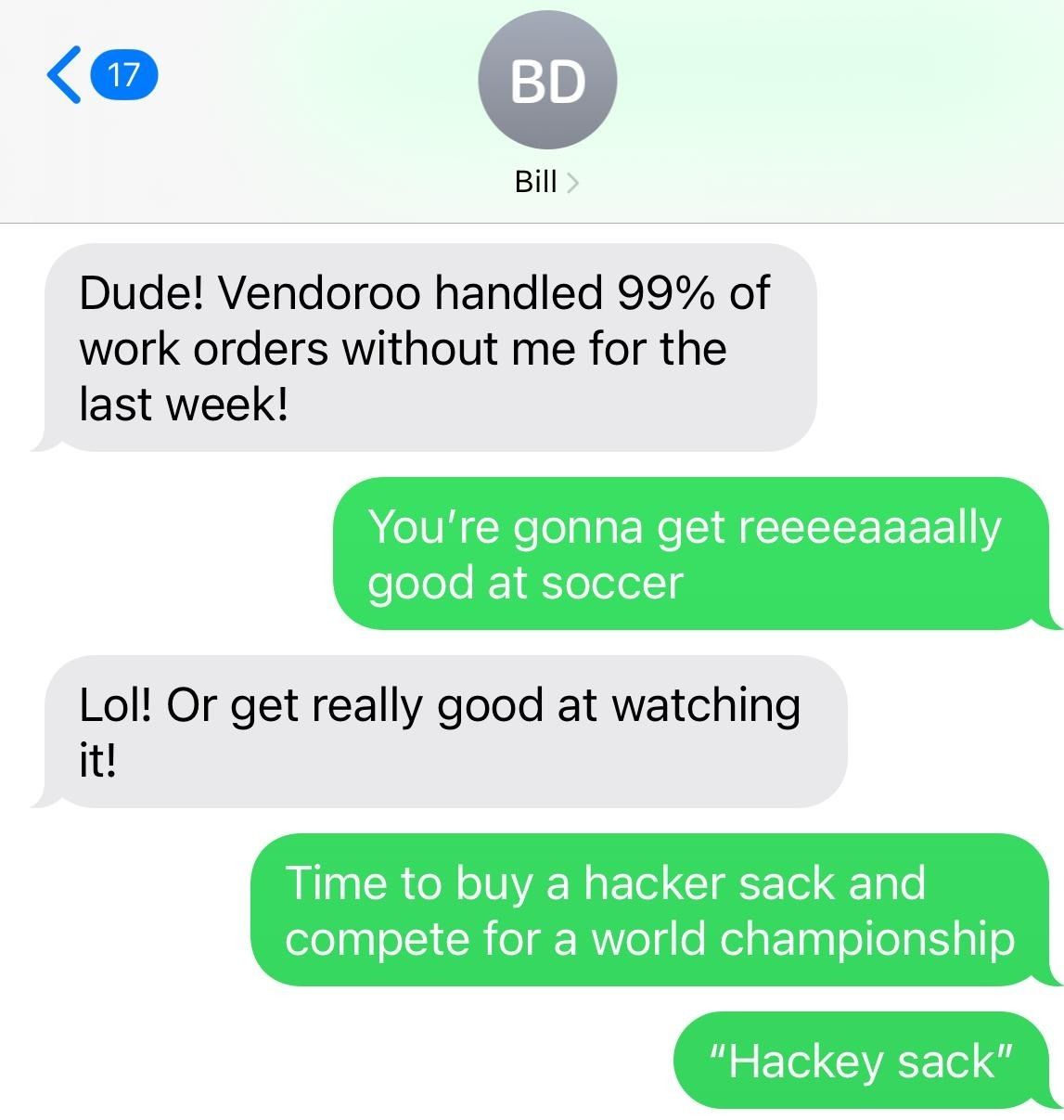
- Weeks of 90% maintenance automation (like this week, Bill texted me about).
- Companies adding 40+ new doors without the need to hire any new staff.
- And most recently, a holiday season where more property managers than ever actually got to take time away from their phones to be present with their families.
That last one is the one we’re really riding high on at team Vendoroo, and here is what the latest data is telling us:
When using Vendoroo as their teammate, 1 maintenance coordinator is capable of handling 2,000 doors alone.
THAT is why you want to find your ideal AI integrator- because you’ll have a super-powered team that can grow with you without the old growing pains of the non-AI era. This makes finding your Sal (or Bill) one of the highest leverage activities you can do.
It’s time to stop trying to learn it all yourself.
Pablo Gonzalez,
Chief Evangelist at Vendoroo
P.S. We can help! Book a call with our team (at vendoroo.ai), so we can show you how we set your existing maintenance operation up for success (in as little as an hour), so you can start uncovering who that AI integrator will be on your team, or have the bandwidth to go look for one.