AI in practice
3 Terms Redefining AI For Property Managers
3 Terms Redefining AI For Property Managers: The New Language of Agentic AI
🎧 Listen to the Audio Version
A demarcation point in language represents a demarcation point in thinking.
I didn’t fully understand how true that was until I heard the word “agentic” for the first time.
Up to that point, we were lumping “AI” together like it was one thing, like SaaS was one thing. But agentic made the difference obvious. This isn’t just better software. This is the first time technology behaves like a hire. It takes action. It follows through. It closes loops. And if you keep thinking about it like a tool in your stack, you’ll aim your strategy at the wrong target.
That’s why we’ve been so loud about helping PMs understand agentic AI, not just “use” it. Because the moment you use the right language, you stop shopping for features and you start building the org chart that can actually get the outcomes you’ve always wanted to deliver.
So this week I want to give you three “from to” shifts. Think of them as a mental model you can use on Monday. If you can name the shift, you’ll know what to change in your strategy, your expectations, and your org chart to actually get the outcomes agentic AI promises.
FROM SYSTEM OF RECORD TO SYSTEM OF ACTION
You’ve been running two separate worlds this whole time, and you didn’t have a name for it: system of record and system of action.
The system of record kept getting better. Ledgers to spreadsheets to RentManager, AppFolio, Rentvine. Cleaner histories. Better reporting. Less “where did we put that?” The system of action, though, never really changed. It was always people, plus phones, plus email, plus texts, plus vendor follow ups, plus the sticky note you swore you’d transfer into the notes section later (you didn’t).
Now that line is getting blurry. Not someday. Right now.
Think about a real “what the hell’s going on here?” moment. Owner calls hot. Resident’s mad. Vendor’s ghosting. And you do the classic PM work order dive. You’re digging through estimates, scrolling a text thread, searching your inbox, reading the notes in the PMS, maybe calling someone because the context isn’t actually in the system. It’s in someone’s head.
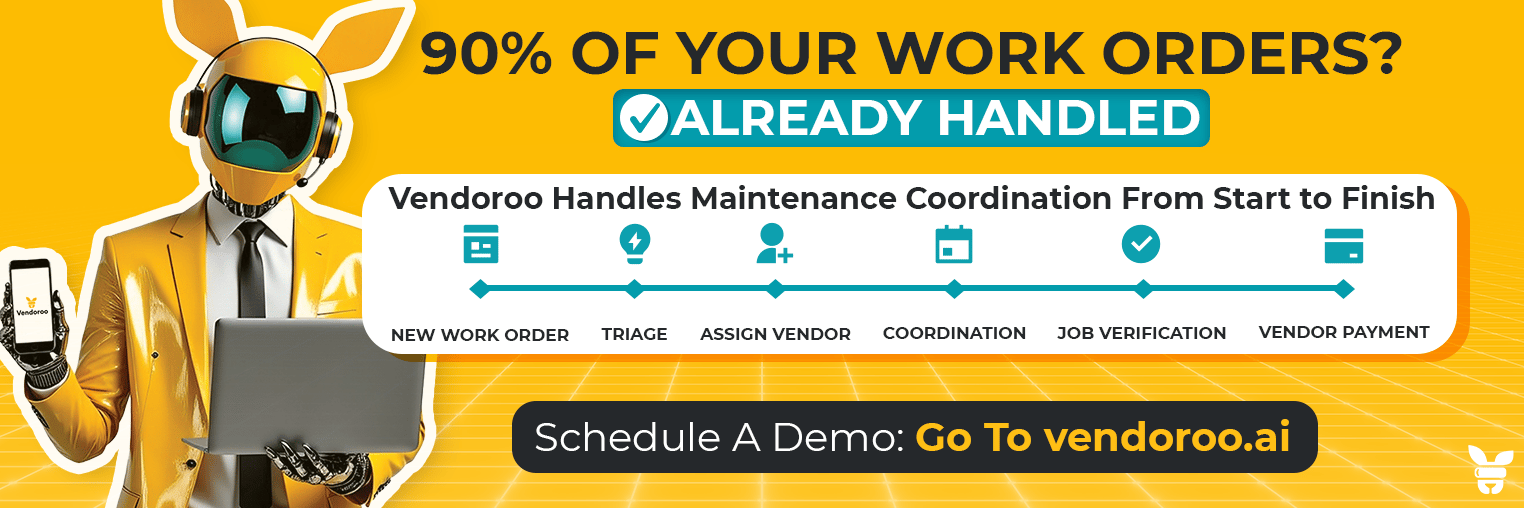
An AI agent takes the first call. It doesn’t just log it and call it a day. It triages the issue, starts troubleshooting over text, and if it can’t fix it, it builds a clean, validated work order. Then it picks the vendor, coordinates access, follows up, and pulls the completion report. That’s a system of action. But here’s the thing: while it’s doing all that action, it’s also updating the system of record the whole time. Same system. Both at once. So the context doesn’t leak out into a thousand channels and disappear the second your coordinator clocks out.
It’s the same reason Salesforce and HubSpot drive sales teams crazy. The handoff only works if the notes are perfect. But the notes are never perfect because the action happens in calls and DMs and side conversations, and the system of record gets updated when someone remembers. If the thing doing the action is also the thing keeping the record, the handoff stops being a guessing game.
And once you see that, you can’t unsee it. You’ve always had a system of action. It was called your team.
What’s new is that technology is now a crucial part of that team.
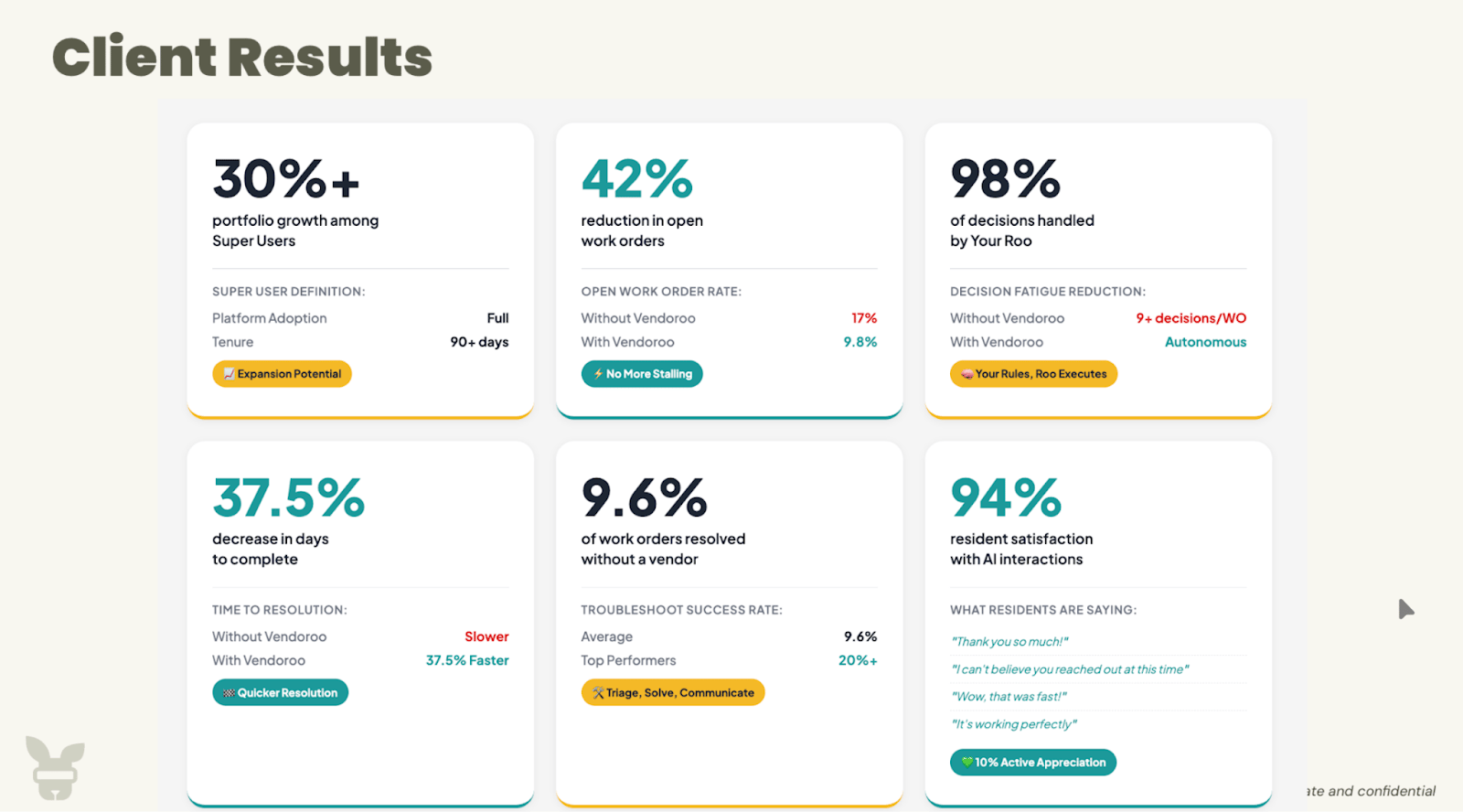
This system of action shift isn’t academic. It’s running in real maintenance queues right now, AI taking the call, closing loops, and documenting everything while your people handle the human stuff. Most importantly, it’s driving real results.
vendoroo.ai
FROM TASK COORDINATOR TO AI TEAM LEAD
This is where the real conflict shows up.
Most operators think AI adoption is a skills problem: prompts, training, stack.
When it’s really a leadership, strategy, expectations problem.
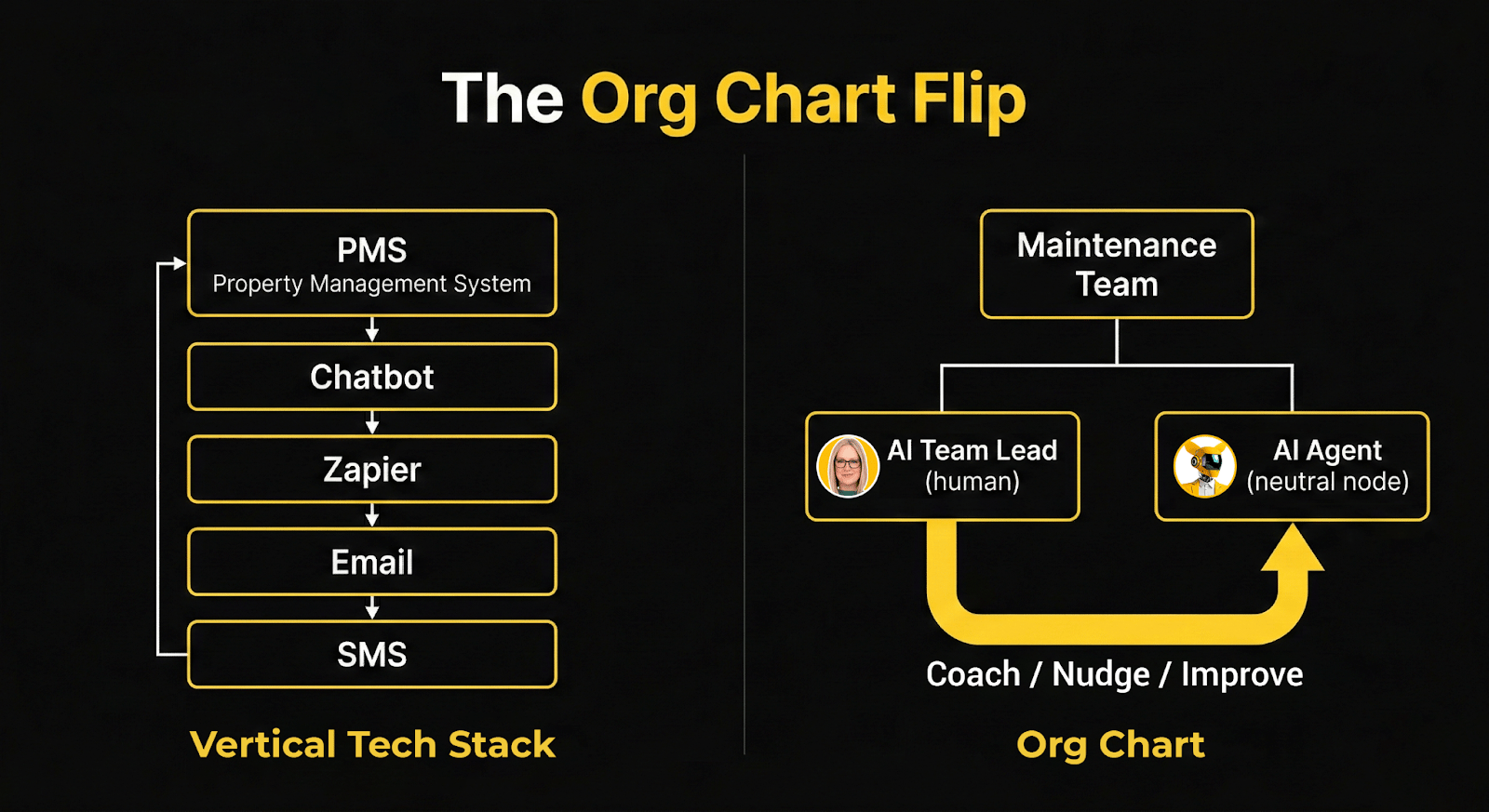
The AI Team Lead isn’t the person who “uses AI the best.”
It’s the person who leads the AI, like a crew. They don’t spend their day doing the 47 micro tasks that turn maintenance into a lifestyle disease. They spend their day coaching, nudging, tightening edge cases, and deciding what “good” looks like when the AI is the one doing the repetitive work.
And here’s the twist. Your best AI Team Lead often isn’t your most tenured property management lifer. It’s the curious tinkerer. The one who keeps asking “why do we do it that way?” The one who already messes with tools on the side, because they can’t help themselves. (If you read our blueprint for finding your AI integrator, you’ve seen this archetype before.)
Bill Davy at Happy Homes is the cleanest example I’ve seen. He came into property management from Lowe’s Home Improvement, no PM background. In his interview, when they asked what he knew about home improvement, he told them: “I know you guys sell hammers and nails, right?”
Once he got the keys, Ron (the owner) basically said: find something that makes your job easier, and then, “this is your project, go forth and show me what you got.” Bill didn’t treat Vendoroo like software he clicked. He treated it like a person he managed:
“I legitimately looked at it as though my employee one is Vendoroo and I do need to teach and train it with the mindset of this is my employee.”
— Bill Davy, Happy Homes
Courtney Parks at Allegiance Property Management, boutique PMC in Northern Virginia, landed in the same place from a totally different angle. Her integrator is Sal (Salvador), a client success manager about 10 years younger, no PM background, originally hired as a leasing coordinator. The tell wasn’t that he knew property management. The tell was that he wouldn’t just ask how to do something. He’d ask why they were doing it that way, and he did it without putting her on defense.
And once Courtney realized it didn’t have to be her, everything changed:
“As soon as I was able to identify who could do it for me and figure out it didn’t have to be me, that’s when we truly became successful.”
— Courtney Parks, Allegiance Property Management
If you’re reading this and thinking, “Wait, I might already have one of these people,” good.
FROM GROWING YOURSELF BROKE TO FIXED COST SCALING
This is the third term, and it’s the one that makes the math undeniable.
Because in property management, growth has always come with a tax. Every growth spurt forces a hire. Fixed cost scaling is the opposite. It means your marginal cost per door stays flatter as you grow.
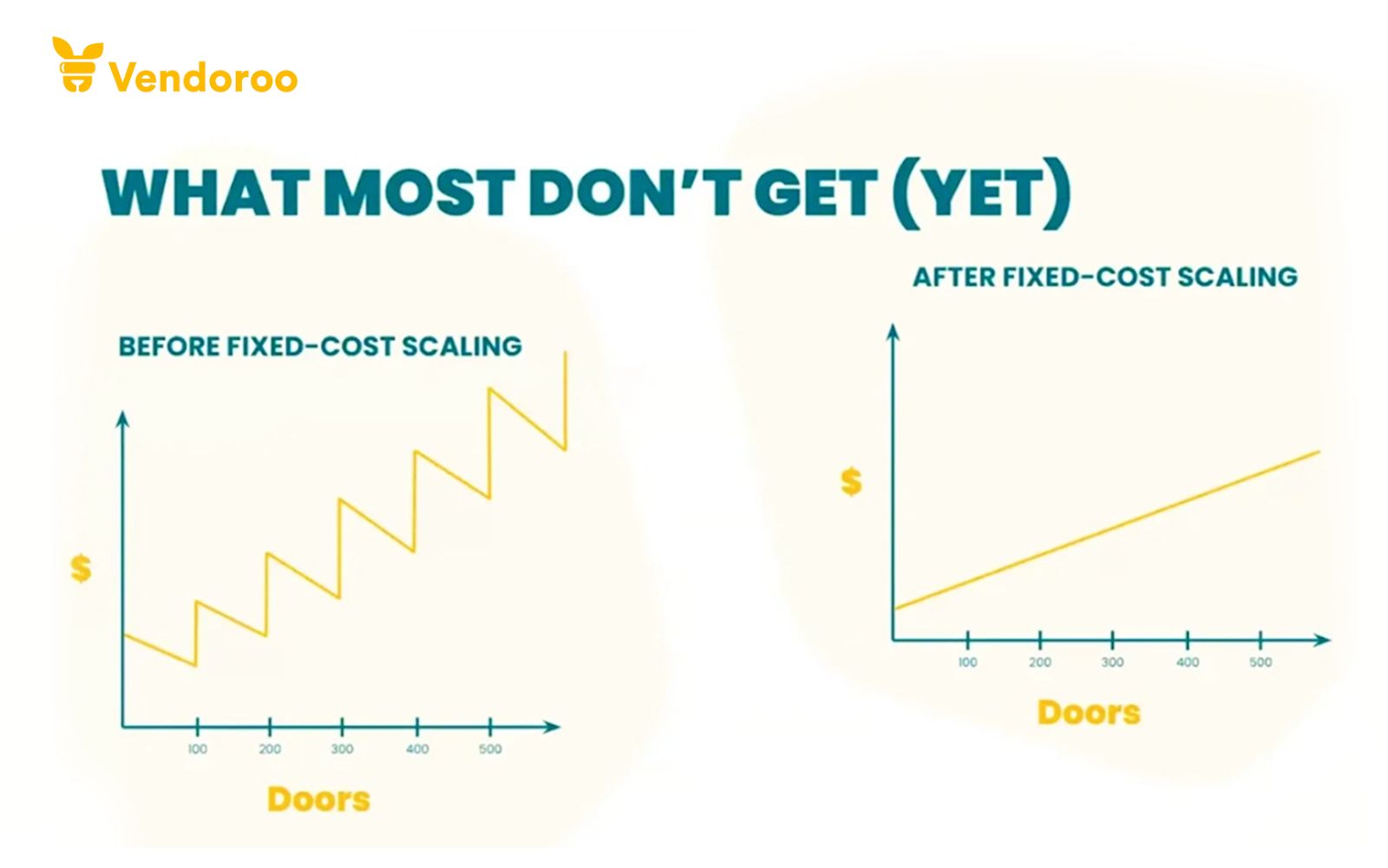
You already know the trap. Every growth spurt forces a hire. Big expense now, payoff later (if ever). Miss on the hire and it’s expensive and demoralizing.
Tim Richards told a story that made it click in my bones. Guy builds a killer fishing lure in his shop. Local bait shop loves it. Then Walmart calls. 500. Then 10,000. Then 100,000. They even front him money to scale up.
Then they squeeze the price.
And suddenly he’s not “growing.” He’s growing himself broke, because his whole cost structure got built around volume he doesn’t control.
Now tie it back to our world. Tim did the math the way only a real operator does. Anybody worth hiring is $5,000 a month, call it $60k a year before you even talk about the fully loaded cost. In his portfolio, average rent is $3,037. So to pay for that one seat, you’ve got to add 16.5 doors just to break even.
And if that person quits six months in, you didn’t just lose time. You sacrificed capacity and momentum. You gave up 16.5 doors for breadcrumbs and a reset.
Fixed cost scaling is the opposite. It’s the idea that with agentic AI, the marginal cost of operating each additional door stays flatter, and the experience stays consistent. It doesn’t sleep. Doesn’t get sick. Doesn’t go on vacation. And if you’re treating it like a hire, you can build predictable capacity at the margin instead of gambling on your next growth spurt.
WHAT IT LOOKS LIKE WHEN IT’S WORKING
Here’s why I keep coming back to Bill Davy at Happy Homes, because he’s not talking about AI like it’s a shiny object. He’s living in the after version of maintenance.
• Out of 30 work orders, he’s deep diving maybe 5
• About 10% get closed without ever sending a vendor out (resident fixes it with the right troubleshooting)
• He’s hit 97% automation weeks
• Cold snap comparison: last year, a pile of HVAC emergencies, this year, one
That’s one person operating inside a system of action, leading like an AI Team Lead, and building toward fixed cost scaling. Not because it’s trendy, but because it’s the first time technology behaves like a hire.
So if you’re staring at your Monday like, “Cool Pablo, how do I actually start?” Don’t start with prompts. Start with your org chart. Who on your team has the tinkerer energy? Who asks “why” without getting spicy? Who can own “making the AI better” week over week? (Also: don’t wait to feel “ready.” That trap has a name- the AI-ready myth)
Agentic AI isn’t a software decision. It’s a hiring decision. And the moment you use the right language, you start building the right org chart.
If you want to see what this looks like inside a real company, hear Bill Davy break down his entire process, how he trains the agent, what he reviews daily, and what changed in his day to day once the system started closing loops.
And if you want the blueprint for finding your AI Team Lead, especially if it’s not you, Courtney Parks lays it out, how she spotted the right person, what traits mattered most, and how it unlocked everything once she realized she didn’t have to be the integrator.
The language changed. The work changed. The only question is whether your org chart is going to catch up.
Pablo Gonzalez
Chief Evangelist at Vendoroo